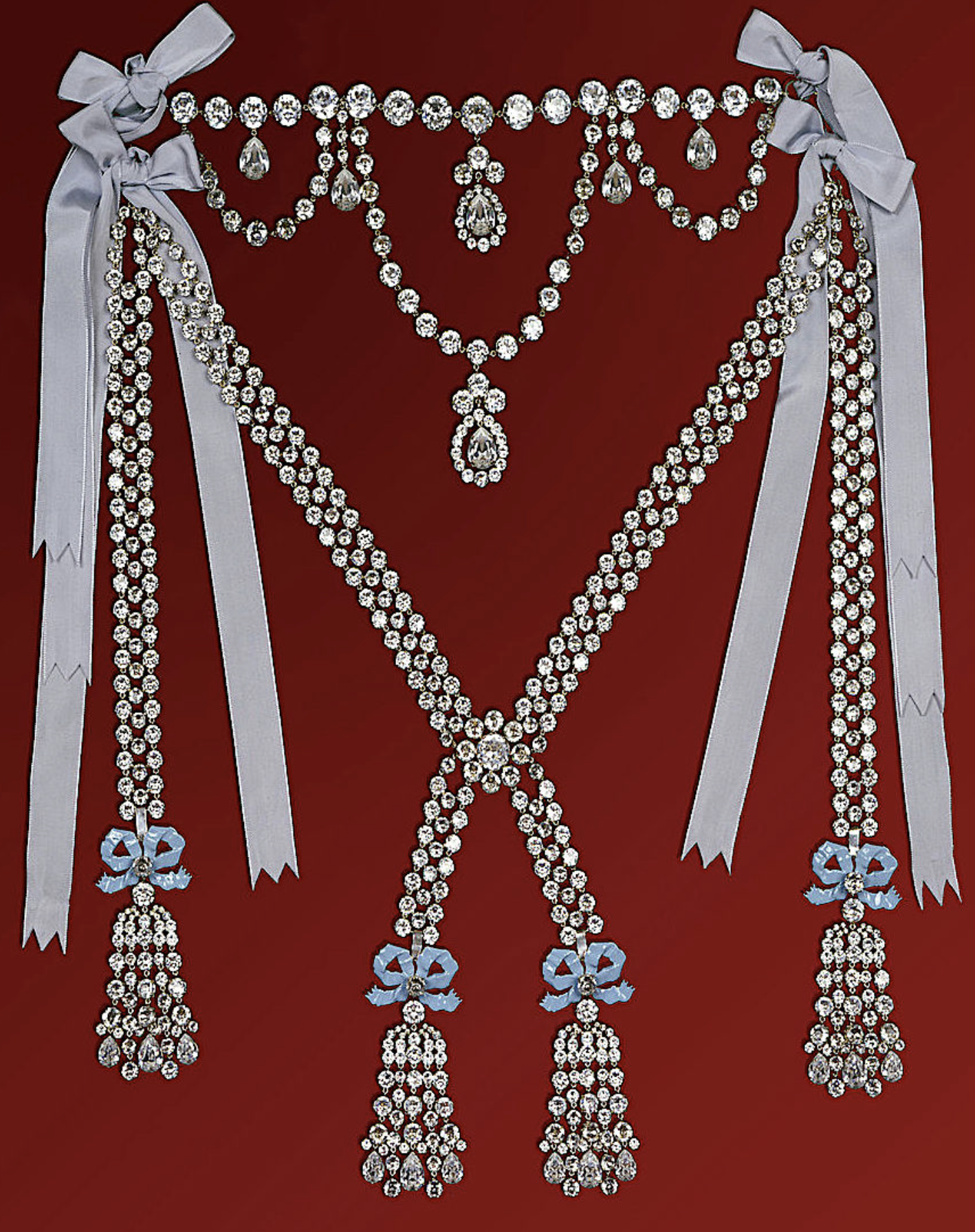
The diamond necklace was commissioned by Louis XV of France for his mistress, Madame du Barry. At the death of Louis XV, the necklace was unpaid for, which almost bankrupted the jewellers and then led to various unsuccessful schemes to secure a sale to Queen Marie Antoinette. Reconstruction, Château de Breteuil (Breteuil Castle), France.
The Affair of the Diamond Necklace
5 minute read - 1300 words.
The Jewel Marie Antoinette Never Owned
Few jewels have caused as much scandal as the extraordinary diamond necklace that became associated with Marie Antoinette. Ironically, the queen never ordered it, never owned it and may never even have seen the completed necklace. Nevertheless, the affair permanently damaged her reputation and became one of the most notorious scandals of the final years of the French monarchy.
A Necklace Made for a Royal Mistress
The story began during the reign of Louis XV. The Parisian jewellers Charles Auguste Böhmer and Paul Bassenge were commissioned to create an exceptionally lavish diamond necklace, reportedly intended for the king’s mistress, Madame du Barry.
The design was deliberately spectacular. It incorporated hundreds of diamonds arranged in elaborate swags, loops and suspended tassels. Descriptions from Versailles place its combined diamond weight at nearly 2,800 carats and its eventual asking price at approximately 1.6 million livres—an astronomical sum even for the French royal court.
Before the necklace could be completed and paid for, Louis XV died of smallpox in 1774. Madame du Barry was sent away from court, leaving the jewellers with a magnificent but almost unsaleable jewel. Böhmer and Bassenge had invested heavily in acquiring the diamonds and now faced serious financial difficulties.
They consequently turned their attention to the new queen, Marie Antoinette. The necklace was reportedly offered to her more than once, including around the birth of her first child in 1778 and again following the birth of the Dauphin in 1781. On both occasions, she refused it. Its enormous cost was difficult to justify, and its original association with Madame du Barry can hardly have made it more attractive.
A Cardinal Desperate to Regain the Queen’s Favour
The next central figure was Cardinal Louis de Rohan, one of the most senior churchmen in France. Although wealthy, well-connected and Grand Almoner of France, he had fallen out of favour with Marie Antoinette. She distrusted him and had effectively excluded him from her circle.
Rohan was eager to restore his position at court. This made him the perfect target for Jeanne de Valois-Saint-Rémy, who styled herself the Comtesse de La Motte. Jeanne claimed to have privileged access to the queen and persuaded the cardinal that she could arrange a reconciliation between them. In reality, she had no meaningful relationship with Marie Antoinette and was constructing an elaborate confidence trick.
Jeanne and her accomplices began producing letters that appeared to come directly from the queen. The correspondence became increasingly personal, convincing Rohan that Marie Antoinette was secretly willing to forgive him.
The Queen Who Was Not the Queen
The most theatrical episode took place on the night of 11 August 1784 in the gardens of Versailles.
Jeanne arranged for Rohan to meet a woman whom he believed to be Marie Antoinette. The impostor was Nicole Le Guay d’Oliva, a young woman who bore a superficial resemblance to the queen. She was dressed in a simple white muslin gown of the kind associated with Marie Antoinette’s private style at the Petit Trianon.
The meeting was deliberately brief and took place in the shadows of the Queen’s Grove. In the darkness, Rohan saw what he wanted to see. The supposed queen reassured him that his past behaviour would be forgiven, and the cardinal left convinced that he had secretly regained royal favour.
It is one of the strangest details of the entire affair: one of the highest-ranking churchmen in France was persuaded that the Queen of France had arranged a clandestine nighttime meeting with him in a dark corner of the palace gardens.
An Almost Comically Bad Signature
The forged correspondence eventually led to a document authorising the purchase of the necklace. It carried the words “Approved” and the signature “Marie Antoinette de France.”
To anyone familiar with royal protocol, this should have raised immediate suspicion. Queens did not ordinarily sign documents in this form. According to the later recollections of Madame Campan, one of Marie Antoinette’s attendants, Louis XVI himself asked how a prince of the House of Rohan and Grand Almoner of France could possibly have believed that the queen would sign herself “Marie Antoinette de France.”
Yet Rohan was so eager to believe that the queen trusted him that he overlooked the mistake. His desire to return to royal favour appears to have been stronger than his judgement
The Necklace Disappears
Convinced that he was acting on the queen’s private instructions, Rohan negotiated with Böhmer and Bassenge. Payment was to be made in four instalments over a period of two years.
The jewellers were relieved. After years of unsuccessful attempts to find a buyer, they believed that the queen had finally agreed to purchase their masterpiece. On 1 February 1785, they handed the necklace to the cardinal.
Rohan then delivered it to someone he believed to be a representative of Marie Antoinette. Instead, it passed into the hands of Jeanne de La Motte and her accomplices.
The necklace was rapidly dismantled. The diamonds were removed from their settings and offered individually for sale. Some were sold in Paris, while Jeanne’s husband travelled to London, where further stones were dispersed. Once separated from their distinctive setting, the diamonds became extremely difficult to trace.
The great necklace one of the most ambitious jewels created in eighteenth century France effectively ceased to exist.
The Letter Marie Antoinette Threw Away
The deception might have continued for longer had Böhmer not attempted to contact the queen directly.
On 12 July 1785, the jeweller sent Marie Antoinette a letter referring to the necklace. Because she knew nothing about the purchase, she did not understand the message and reportedly destroyed the letter.
When payment still failed to arrive, Böhmer approached Madame Campan and expressed his concern that the queen had not honoured the agreed instalment. Campan, equally confused, informed Marie Antoinette. The queen demanded an immediate explanation, and the fraud began to unravel.
The jewellers had assumed that the queen was avoiding payment. The queen, meanwhile, had no idea that anyone believed she had purchased the necklace.
An Arrest in the Hall of Mirrors
The scandal became public in spectacular fashion.
On 15 August 1785, shortly before he was due to take part in the Assumption Day service in the Royal Chapel, Cardinal de Rohan was summoned before Louis XVI and Marie Antoinette.
Confronted with the documents, the cardinal realised that he had been deceived. Nevertheless, the king ordered his arrest. Rohan was taken into custody as he left the royal apartments and entered the Hall of Mirrors, surrounded by astonished courtiers.
Rather than dealing with the affair discreetly, the monarchy had arrested one of France’s most prominent aristocrats in one of the most public spaces at Versailles. News spread rapidly through the court and then across Paris.
A Trial That Damaged the Innocent Queen
The subsequent trial became a public sensation. Rohan was brought before the Parlement de Paris, while Jeanne de La Motte and several of her accomplices were also prosecuted.
In May 1786, the cardinal was acquitted. Jeanne was found guilty, publicly punished and branded with the letter V, for voleuse—thief. She was sentenced to imprisonment at the Salpêtrière. She later escaped and fled to London, where she continued to publish accusations against the queen.
Legally, Marie Antoinette had been entirely innocent. She had not commissioned the necklace, had not authorised the purchase and had never received the diamonds.
Public opinion, however, did not treat her as an innocent victim. The acquittal of Rohan was widely interpreted as a humiliation for the monarchy. Many people found it believable that the queen might secretly acquire an enormously expensive necklace while attempting to conceal the purchase from the king and the public.
That assumption alone revealed how badly her reputation had already deteriorated.
The Necklace That Survived Only as an Image
The original necklace was never recovered. Because the diamonds were removed and sold separately, no complete piece survived for later generations.
Modern reconstructions are largely based on an eighteenth-century print showing the design to scale. Replicas at the Château de Breteuil and the Château de Versailles provide an impression of the necklace’s extraordinary size and complexity, but they are reconstructions rather than the original jewel.
The Affair of the Diamond Necklace did not by itself cause the French Revolution. It did, however, deepen the growing distrust of the court and strengthened the popular image of Marie Antoinette as extravagant, secretive and indifferent to France’s financial difficulties.
The final irony is that the most notorious jewel associated with Marie Antoinette was one of the few great jewels she had firmly refused to buy. She never wore it, never owned it and never authorised its purchase—yet its name would remain inseparably connected with hers.
